

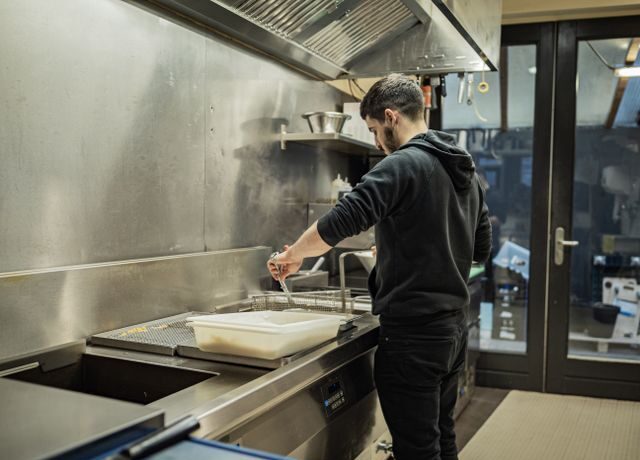
It’s even possible that the most pristine commercial kitchen in Grafton that has received a food safety certificate through a proper food safety inspection, and which has maintained an impeccable level of hygiene while doing clean-downs every night, may in actuality have hidden risks of fire in its extraction system. There is no correlation between the two. Surface cleanliness and ductwork integrity are two very distinct entities that employ a completely different approach to cleaning, involve completely different people, and use completely different machines.
The discrepancy between the two represents a gap where the largest kitchen hazards lie, making grease cleaning Grafton a critical priority.
Grease Is a Kitchen’s Most Persistent and Most Overlooked Problem
All cooking services produce airborne grease which gets into the ventilation system. Filters filter out part of it, but fine particles will continue through the system and deposit themselves on the duct walls, accumulate in the bends and cover the fan assembly. The speed of this accumulation fully depends on the kind of cooking. When a kitchen operates continuously using deep fryers, it produces much more airborne grease in the duct compared to a kitchen operating ovens moderately. This factor should be the basis for planning cleaning work, not a general schedule.
The Restaurant Fire Safety in NSW Fire and Rescue provides a list of the typical sources of restaurant fires, stating that one of the most common ones is the ignition of fatty residue in the rangehood and ducting systems. In its best practices guide “Commercial Kitchen Exhaust Management” (2022), AIRAH mentions that fires in the duct can burn so hot that the heat from it, conducted through the duct wall, can cause ignition of combustible substances around the duct without direct burning contact. A grease-filled duct is not just unclean. It is a danger factor spreading throughout the whole building.
What a Complete Grease Clean Covers in Grafton?
Professional grease clean-up includes the entire path of air and not just what you see. This includes the interior of the canopy hood, all filter types and their respective housings, the ductwork from where the duct connects with the hood up to the fan, the fan housing and the impeller, and finally the exit point of the discharge. In situations where there are no access panels in kitchens, a specialised contractor would point out any deficiencies in order to rectify the situation for future servicing.
The grease level needs to be checked at pre-defined test points both before and after the clean-up. This is not an administrative requirement but the data point that allows the contractor to determine when the next service is required. According to the AIRAH 2022 guidelines, it is recommended to base the cleaning requirements on the grease build-up rate and not on any pre-set time periods since two kitchens could have completely different grease build-up rates even if they are serviced on the same schedule.
How Grafton’s Trading Patterns Create Specific Cleaning Considerations?
The hospitality industry of Clarence Valley is far from being uniform throughout the year. River dining, pub business, and cafe business catering to the local population are subject to spikes related to tourism and events, as well as seasonality of visitors. The kitchen operating under increased load during the peaks generates grease at a much higher rate and the cleaning schedule adjusted for the normal trading level does not allow keeping up with the increased production of a kitchen working at double speed.
Businesses which change their cooking style depending on the season of the year encounter a similar issue. A menu including more frying and braising in the cooler season creates more airborne grease per service than a light menu prepared in the warm weather months, despite the similar number of covers served. Additional inspection following each spike in trading is a sensible action for any kitchen in Grafton whose volume varies throughout the year.
The Record-Keeping Requirement Which Most Operators Overlook
The Council of Clarence Valley requires all food businesses to register and performs inspections of these enterprises conducted by Environmental Health Officers. The physical state of the premises is one of the elements of this inspection, and the absence of documentation of maintenance of the extraction system means the inability to prove compliance solely relying on evidence.
If the extraction system is included as one of the important measures of fire safety in the Fire Safety Schedule of the building, NSW law obliges keeping maintenance records for at least seven years and an annual Fire Safety Statement including these records. In addition to the regulatory requirement, maintenance conditions are often included in the insurance policies for commercial kitchens and may influence the fire claims assessment procedure depending on the specifics of the insurance policy wording and the approach of the insurer.
There is a big difference between a clean kitchen and a documented kitchen. Now in Grafton only the latter is required for compliance.